Leadership Blind Spots at Home and at Work: What the “Blindsided Husband” Data Teaches Us About Burnout, Culture, and Responsibility
Leadership failure rarely announces itself loudly. It accumulates quietly through missed signals, deferred conversations, and assumptions that silence equals stability. The recent analysis from Dellino Family Law Group, reinforced by research from Stanford University, reveals a sobering reality: 69 percent of divorces are initiated by women, and men are almost always shocked when it happens.
At first glance, this looks like a relationship issue. In reality, it is a leadership issue.
The same blind spots that derail marriages are showing up daily in boardrooms, executive teams, and organizations struggling with burnout, disengagement, and culture erosion. Leaders who believe “no complaints means everything is fine” are often the last to know when collapse is imminent.
The Hidden Parallel Between Marriage and Organizational Culture
Dellino Family Law Group attorneys report a consistent pattern. Wives process dissatisfaction for three to five years before filing. Husbands often discover months or years of quiet preparation only after divorce papers arrive. Emails with attorneys, financial planning, and emotional closure have already happened.
In organizations, this same dynamic plays out when employees disengage long before they resign.
By the time a high performer leaves, they are already emotionally done. Exit interviews reveal issues leadership insists were never raised. Managers say, “If something was wrong, they would have told me.” Employees respond internally, “I tried. It did not matter.”
Burnout does not explode. It erodes.
As explored in prior Breakfast Leadership Network analysis on early burnout indicators, disengagement almost always precedes visible crisis. Leaders who ignore weak signals create cultures where silence replaces safety.
https://BreakfastLeadership.com/blog
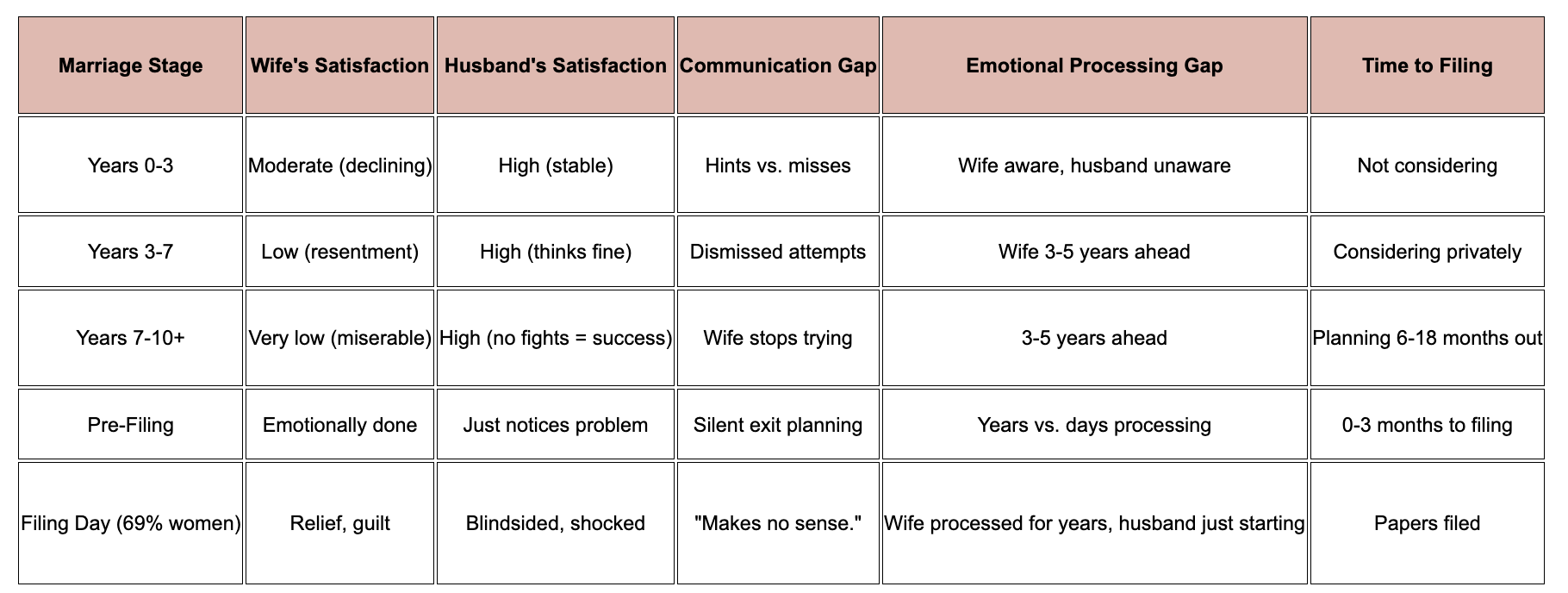
Source: Delino Family Law Group
The Communication Gap Is Not About Effort. It Is About Perception.
The data shows a consistent gender perception gap. Women drop hints because they fear being dismissed. Men expect direct communication and believe no conflict equals success. Both feel unheard.
This mirrors workplace dynamics uncovered in emotional labor research and organizational psychology studies published by the American Psychological Association and Harvard Business Review. Employees who repeatedly raise concerns that go nowhere eventually stop raising them. Silence becomes self-protection.
In marriage, that silence precedes divorce.
In organizations, it precedes attrition, presenteeism, and cultural decay.
Leadership is not measured by the absence of complaints. It is measured by the presence of psychological safety.
Why Leaders Cannot Separate Work Leadership From Home Leadership
One of the most dangerous myths leaders carry is that leadership is situational. That they can be emotionally absent at home while being effective at work, or vice versa.
Leadership is a behavior pattern, not a job description.
The same traits that produce blindsided spouses produce blindsided executives:
• Assuming stability without verification
• Avoiding uncomfortable conversations
• Confusing lack of conflict with trust
• Outsourcing emotional labor to others
• Reacting only when crisis becomes unavoidable
Burnout thrives when leaders compartmentalize responsibility. When they believe emotional awareness belongs “over there,” not here.
As discussed in Breakfast Leadership Network’s work on sustainable leadership under pressure, leaders who fail to lead at home eventually fail at work. Cognitive load, unresolved tension, and emotional blind spots do not stay contained.
https://BreakfastLeadership.com/blog
The Cost of Being Emotionally Behind
Dellino Family Law Group highlights a critical consequence: timing matters. The spouse who is emotionally ahead enters legal proceedings prepared. The blindsided spouse scrambles.
The same is true in organizations.
Leaders who recognize disengagement early can intervene, rebuild trust, and retain talent. Those who wait until resignations or performance failures occur face higher turnover costs, reputational damage, and legal exposure.
Research cited by Harvard Business Review consistently shows that delayed leadership intervention increases conflict, reduces cooperation, and escalates financial and human costs. Once trust is gone, recovery becomes exponentially harder.
Burnout follows the same curve. Early signals are reversible. Late-stage burnout is not.
Emotional Labor Is Leadership Labor
One of the most uncomfortable truths in the data is this: women often carry the majority of emotional labor in relationships. They track problems, attempt repair, and absorb resistance until exhaustion sets in.
In organizations, the same pattern often falls on HR leaders, DEI professionals, and middle managers. They notice culture fractures long before executives do. When warnings are ignored, these leaders burn out first.
Leadership is not about mind-reading. It is about intentional listening.
Organizations that rely on “open door policies” instead of structured feedback systems are no different than spouses who say, “You should have told me,” while ignoring every prior attempt.
What This Means for Modern Leaders
This data is not an indictment of men. It is a warning to leaders of all genders.
If you are shocked when someone leaves, disengages, or files paperwork, the signals were likely present long before you noticed.
Leaders must:
• Treat silence as a risk indicator, not reassurance
• Normalize direct, psychologically safe communication
• Act on weak signals before resentment hardens
• Lead with the same presence at home and at work
• Recognize burnout as a relational failure, not an individual weakness
Culture is built in the moments people decide whether it is safe to speak. Marriage ends when that safety disappears. Organizations unravel the same way.
As Dellino Family Law Group notes, courts do not care about surprise. They care about preparedness. The same is true of markets, employees, and families.
Leadership requires showing up before the papers arrive.
Final Thought
You cannot lead well at work while ignoring leadership at home. You cannot build culture in organizations while neglecting culture in relationships. Burnout, whether personal or organizational, is rarely sudden. It is the result of leaders mistaking quiet for calm.
And by the time calm breaks, it is often too late.