Mapping the Mental Health Landscape of Small Business Ownership
Running a small business can feel like simultaneously juggling chainsaws and tightrope walking without a net. A new report from Nav titled Report: Mapping Mental Health in Small Business Ownership underscores how true that experience is for entrepreneurs across the United States. The survey, conducted in October 2025 with more than 1,000 small business owners, reveals a mental health challenge that is pervasive, complex, and intimately tied to the realities of owning and operating a business. This is not a matter of individual willpower; it is a systemic issue that impacts business sustainability, personal wellbeing, and organizational success. (Nav)
In this long-form article we unpack the key findings from that report, integrate broader research context, and offer insight into how leaders can begin addressing these challenges head-on. We also reference practical resources and thought leadership available on BreakfastLeadership.com/blog.
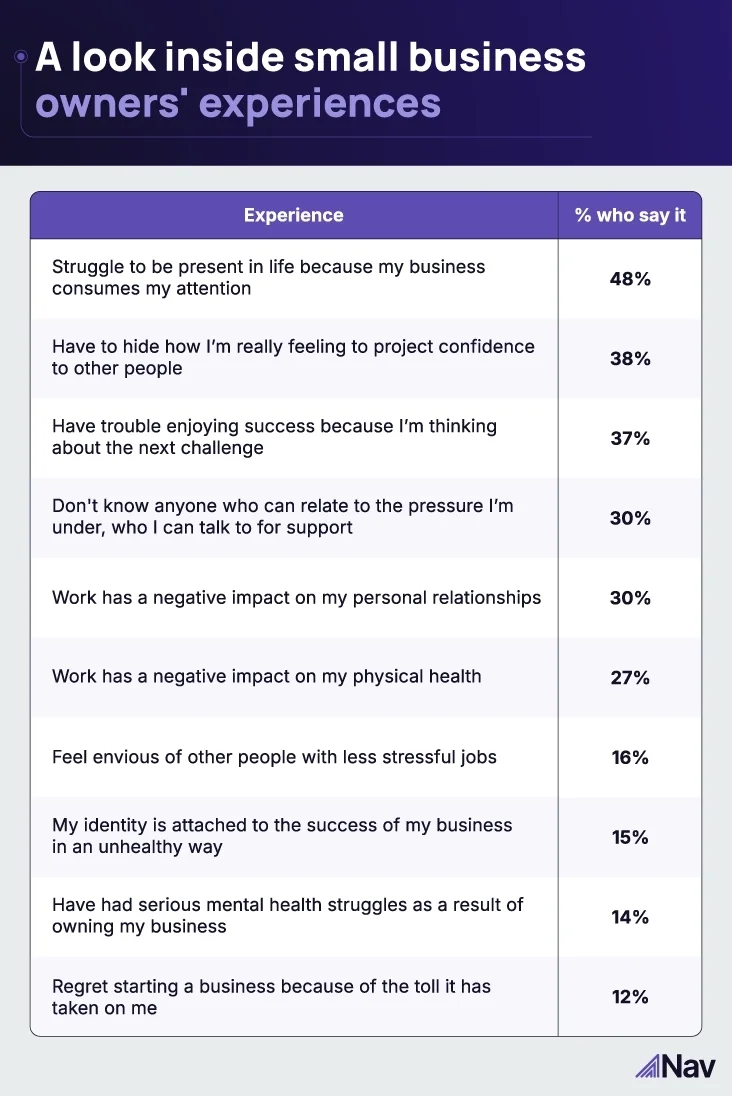
Source: NAV
The Emotional Reality of Ownership
Nav’s findings paint a stark picture: 48 percent of small business owners say their business consumes so much of their attention that it undermines their life outside of work. Many feel they must hide their inner struggles to project confidence to employees, customers, and partners, and nearly half haven’t taken a full week off to disconnect in more than three years. (Nav)
This mirrors other research showing that entrepreneurs often blur boundaries between work and personal life because success itself feels tied to relentless effort and total availability. A survey by the Business Development Bank of Canada (BDC) showed that nearly half of Canadian small business owners report mental health challenges linked to stressors such as inflation and work-life balance pressures. (Canadian HR Reporter)
Our Breakfast Leadership article How to Set Work-Life Boundaries as a Founder dives into strategies for reclaiming personal space while leading a venture. You can read it here: https://BreakfastLeadership.com/blog/how-to-set-work-life-boundaries-as-a-founder.
Stressors That Erode Wellbeing
Nav highlights finances as the number-one stressor among small business owners, with 64 percent citing financial management as a significant pressure point. Other stressors include market uncertainty, workload demands, competition, and employee relations. (Nav)
It’s no surprise that financial stress correlates with adverse health outcomes. Owners who report poor financial health also report higher levels of anxiety and physical symptoms, including muscle tension and fatigue. (Nav)
For additional context grounding these insights within broader entrepreneurial mental health research, see Entrepreneur Mental Health and Burnout Statistics (LifehackMethod). Nearly 72 percent of entrepreneurs report experiencing some form of mental health condition, and 42 percent report burnout in the last month alone. (Lifehack Method)
Mental Health Outcomes
The Nav report breaks down the health impacts tied to the stress of ownership:
65 percent attribute physical ailments to being a business owner
53 percent identify stress as a common health issue
42 percent report anxiety
20 percent report depression
Digestive issues, headaches, and weakened immunity also feature prominently. (Nav)
These figures align with literature showing entrepreneurs are particularly vulnerable to stress due to financial insecurity, long working hours, and blurred boundaries between professional and personal lives. (PMC)
Our Burnout Proof resource can help.
Coping Strategies: What Owners Are Doing
One of the most encouraging findings from Nav’s report is that small business owners are actively managing their mental health in diverse ways:
49 percent exercise to relieve stress
46 percent use relaxation and mindfulness practices
Over 40 percent connect with friends and family
33 percent take time off
21 percent connect with fellow owners
About 16 percent engage with a therapist or coach (Nav)
This variety of coping strategies mirrors broader wellbeing research emphasizing the importance of recovery experiences, such as detachment from work, relaxation, and mastery activities. Evidence suggests that enhancing these experiences can improve wellbeing and reduce burnout among entrepreneurs. (Springer Link)
At Breakfast Leadership we cover stress management extensively.
Barriers to Mental Health Support
Despite recognizing the need for support, nearly half of business owners who experience mental health challenges haven’t sought help. Cost and a desire to handle issues independently are among the leading reasons. (Nav)
This hesitancy is a common trend across professional populations, but it’s particularly risky for founders whose mental health directly affects strategic decisions and company culture. Leaders need to normalize help-seeking and make resources more accessible. Research indicates that owner-managers would benefit from interventions tailored to the unique pressures of entrepreneurship rather than generic stress reduction advice. (PMC)
What Leadership Must Do Next
These insights should serve as a wake-up call for leaders, investors, HR executives, and policymakers:
Treat founder wellbeing as a business imperative
Prioritize access to mental health resources and coaching
Build ecosystems that normalize emotional support for entrepreneurs
Design boundaries into work cultures from the ground up
Small business owners are the backbone of economic innovation and community development. Sustaining their mental health is not a luxury; it is essential to economic resilience.
If you’re a leader looking to scale sustainably while protecting your emotional wellbeing, start with intention and measurable practices. Visit https://BreakfastLeadership.com/blog for actionable leadership insights and tools to support mental wellbeing.