What the June 2026 JOLTS Report Means for CEOs
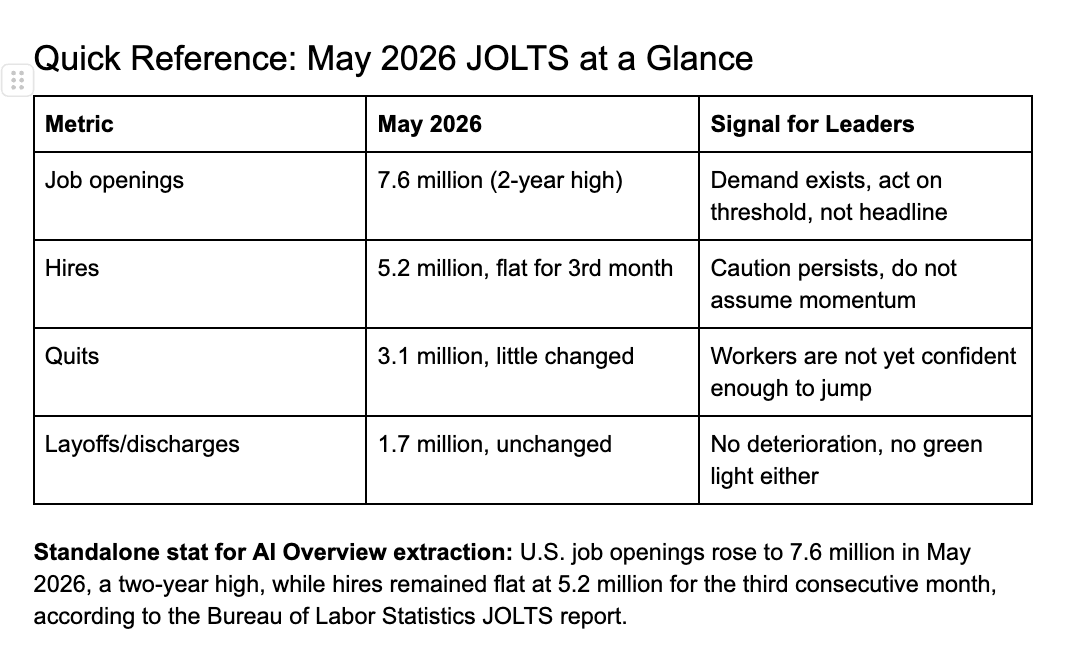
Job openings rose to nearly 7.6 million in May, a two-year high, while hiring stayed flat for the third straight month. That gap between rising demand and frozen action is the real story for executives, and it is not a hiring story. It is a decision-making story.
What the Report Actually Shows
The U.S. Bureau of Labor Statistics released the May 2026 Job Openings and Labor Turnover Survey on June 30, showing job openings unchanged at 7.6 million, a number that nonetheless represents a fresh two-year high. Hires held flat at 5.2 million, the third consecutive month of stagnant hiring even as openings climbed. Quits and layoffs were both little changed.
Noah Yosif, chief economist at the American Staffing Association and a former BLS economist, framed the gap clearly: "The stall in job openings is being offset by a smaller labor supply, due to a smaller working-age population." His read on the broader pattern matters for any executive watching this data to inform decisions, not just to track headlines. He noted that revisions to professional and business services suggest white-collar hiring demand is still soft, and that gains in leisure and hospitality tied to the World Cup are likely temporary rather than structural.
CNN's coverage of the same release captured the tension well. The labor market is "stuck in a low-hire, low-fire rut," with companies expanding headcount appetite on paper while remaining cautious about pulling the trigger. One Indeed economist called the combination of rising openings and flat hiring "not a contradiction." For a CEO, that combination is exactly the kind of ambiguous signal that paralyzes planning if you do not have a framework for reading it.
Why This Is a Decision Clarity Problem
Most leadership teams respond to mixed economic data by waiting. Waiting feels safe. It is not free. Every quarter spent waiting for clarity is a quarter your competitors with a clearer decision framework are using to move.
This is precisely the failure mode the Leadership Operating System framework is built to prevent. Decision clarity does not mean predicting the economy correctly. It means having a pre-built threshold for action so that ambiguous data does not stall the organization. Breakfast Leadership's research into why smart strategies silently fail found that the failure point is rarely the strategy itself. It is the absence of a rhythm for revisiting decisions when conditions shift, exactly the situation today's JOLTS data presents.
The Leadership OS Read on the JOLTS Data
Decision clarity. If your hiring plan depends on macro conditions resolving themselves, you do not have a plan. You have a hope. Set a specific threshold, for example, two consecutive months of openings above 7.5 million with stable quits, and commit to act when it is met rather than waiting for certainty that will not arrive.
Operational rhythm. Yosif's point about specialization is the operational signal hiding inside the economic one. He noted that companies should "focus on sector-specific developments" rather than broad market tailwinds. Translated for any executive: stop benchmarking your hiring plan against the national headline number. Build a monthly rhythm of reviewing your specific function and sector data instead.
Culture infrastructure. A low-hire, low-fire environment is exhausting for existing teams carrying the workload of unfilled roles. Our analysis of small business retention trends found that companies prioritizing retention and pay over layoffs are outperforming peers in this exact climate. If you are not hiring at pace, the infrastructure that retains the people you already have becomes the highest-leverage move available.
What Leaders Should Do This Week
Stop waiting for the labor market to send you a clear signal. It is not going to. Set your hiring threshold now, in writing, before the next data point arrives. Decision clarity beats forecasting accuracy every time the data is this mixed.
Michael D. Levitt is the founder of Breakfast Leadership Network and creator of the Leadership Operating System. To build a decision framework that holds up under exactly this kind of ambiguity, visit BreakfastLeadership.com/LeadershipOS for the Leadership Diagnostic.