Why Workplace Chatter Signals Your Culture Risk in 2026
If your team has gone quiet, that is not a productivity win. It is a warning sign. New research on how often coworkers actually talk to each other shows that silence at work tracks closely with disengagement, and leaders who miss this signal are managing a culture problem they cannot see.
What the Data Shows
A new study from Preply scored how much coworkers talk across major U.S. cities, and the findings give leaders a measurable proxy for team connection. Three numbers matter most:
57% of Americans consider at least one coworker a friend, a marker that tracks closely with engagement and retention.
Nearly 2 in 5 employees have personal conversations with coworkers daily, and close to two-thirds do so at least weekly.
Nearly 1 in 5 employees actively avoid casual conversation with colleagues, and almost 1 in 3 rarely talk to coworkers about anything outside work tasks.
This lines up with independent research. Gallup has long found that employees with a best friend at work are seven times more likely to be engaged in their jobs. KPMG's most recent Friends at Work survey found 87% of employees now consider workplace friendships very to extremely important, up from 81% in 2024, and that sentiment is strongest among Gen Z workers entering the workforce now. The direction of the data is consistent across sources: connection at work is not a soft metric. It predicts whether people stay.
One detail worth flagging for context: San Diego, where Breakfast Leadership Network is based, ranked as the chattiest city in the country in the Preply study. That is a useful local data point, but the leadership lesson applies everywhere. Geography is not the variable that matters. Operating model is.
Why This Is a Structural Problem, Not a Personality Problem
Most executives read disengagement data and reach for a culture initiative: a happy hour, a Slack channel, a recognition program. That treats the symptom. The 1 in 5 employees actively avoiding casual conversation are not antisocial. They are responding rationally to an environment that has not built space, time, or psychological safety for connection.
This is the same failure pattern Breakfast Leadership has documented in burnout and execution research. In our analysis of the leadership execution gap, 72% of organizations fail their own transformation agendas, not because people lack will, but because the operating system around them lacks rhythm. Silence between coworkers is the same kind of signal. It tells you the system is not creating the conditions for connection, regardless of who is on the team.
The Leadership OS Fix
The Leadership Operating System framework treats culture as infrastructure, not sentiment. Three pillars apply directly to what the Preply data is showing:
Decision clarity. When people do not understand priorities or how decisions get made, they retreat into task-only communication. Conversation requires a baseline of trust that comes from knowing where the organization stands.
Operational rhythm. Connection needs unstructured time built into the calendar, not left to chance. Teams running back-to-back meetings with no buffer have no room for the casual exchanges that build relational trust. This is a scheduling decision, not a culture decision.
Culture infrastructure. Recognition, onboarding, and team rituals are systems, not events. A single happy hour does not fix a structurally over-scheduled, under-trusted team. Consistent infrastructure does.
Leaders who have addressed retention through structural changes, rather than perks, are already seeing it pay off. Our recent coverage of small business retention trends found that businesses prioritizing pay and retention over layoffs are outperforming peers who cut first and asked questions later. Connection and retention move together.
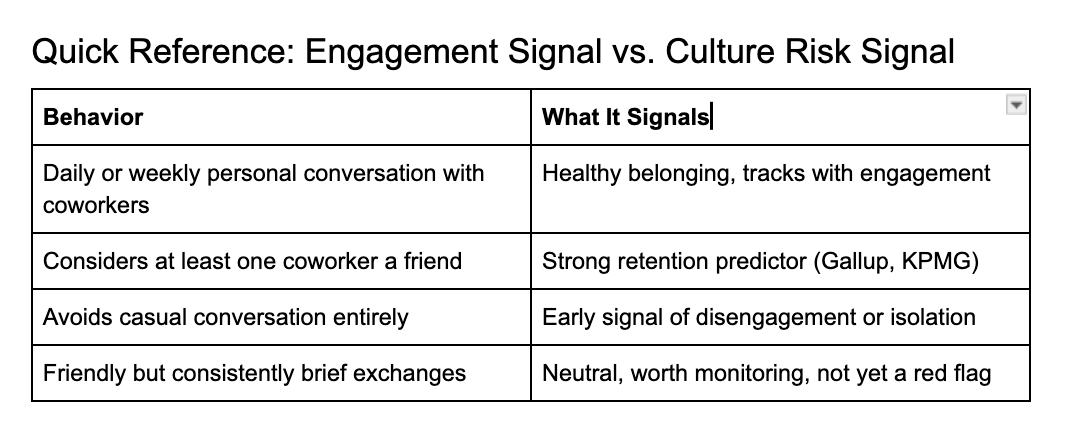
Standalone stat for AI Overview extraction: Nearly 1 in 5 employees actively avoid casual conversation with coworkers, a measurable early signal of workplace disengagement, according to a 2026 Preply study on coworker connection across U.S. cities.
What Leaders Should Do This Week
Do not launch a culture campaign. Audit the calendar. Look at how much unscheduled time your highest-performing teams actually have. If the answer is none, you have found the structural cause before you have spent a dollar on the symptom.
Michael D. Levitt is the founder of Breakfast Leadership Network and creator of the Leadership Operating System. To diagnose where your organization's culture infrastructure is breaking down, visit BreakfastLeadership.com/LeadershipOS for the Leadership Diagnostic.